Game Log 2: Play
Use the following questions as a reference for your documentation. Feel free to edit the format.
From the game-making process:
- What have you learned, what decisions have you made, and how have you progressed in your thinking?
- Share any pictures from your game design process.
From the expert council:
- How was the engagement with the EU values perceived by the expert council?
- What can be improved?
- How playable was the prototype according to the experts?
- What was their feedback regarding the instructions?
- What could be changed to improve it?
- What was their feedback regarding the instructions?
Feedback from Susannah and Paul
Yeah, for me, it's amazing how far you've come. I think this is the first time I've seen something that has really gone so, so, so far, especially with the coming, starting with the pitch of the storyline, why you're doing this, the whole idea behind it. So I'm not just lost, you know? I know, okay, there's a game and this is where they're coming from, and it's a game of interest, of people trying to either choose their personal interest the interest of the whole community as a whole. And I think that's a good start. Like you said, you're trying to figure out how to place what and what to put in the card exactly to really make it a time pressured exercise for the players. So keep it interesting and fun at the same time. So for me, I would just say you already got what you need to do. It's just to figure it out step by step and put the pieces you've got to make sense and keep play testing, play testing. So you see, OK, this is good. You can also feel free to play test with all the teams, or with us, and call us once in a while and come check if this is in order. That's it for me. Thank you. Maybe make that something to say.
Sounds positive.
Exactly. That's what I thought as well. You got rules.
Yeah.
So that shows that you are going to come far, right? And that's great. I thought the water was like the time frame, the time limit. You said, oh, we need like a counter or like a...
Yeah, well, we don't think we need one, but that's maybe to adjust pressure if there's... Not enough pressure in the game, but that's what we're trying to figure out, 'cuz the water cards is just after every round, so every.
Player has the time limit, yeah, when you were talking, but it's great.
It could also be good to put all of this in a sort of manual, try to... oh you read like the instruction of what to put so maybe like explanation of what does this mean yeah yeah so maybe like maybe you put this yeah I saw that in one of the groups you just placed it and like oh yeah like right oh yeah.
Most of the games have like this card or this card cardboard piece where the rules are explained in simple form.
Yeah, very, very simple.
With a picture of the card and then a small.
Maybe put the styles on it and you say, oh, this style stands for this. Maybe see this, so someone just looks. I don't know. It acts you very good.
Yeah, because it's still a little bit chaotic for us now. So I think it would help us.
Could you explain more about the board and how we need to play it? Or see it.
At the beginning, you draw one of the cards, and on the other side, you see how many tells you got that's one and three resources, so you get three resource cards that now is all over the place, but you get three, and you have... What should we say? One.
1.
One tail. So you put your pian on one tail.
Yeah, and at first it starts with a little bit of water somewhere we haven't discussed yet where?
But there are the coordinates for it.
So here we'll also go. OK, but you can do it with his flip cards or something?
Sorry.
Sorry. Normally you can create your game board with placing these tiles and then flip them over.
Yeah.
Something like that. Then you have this randomly created land. Or just a card that says with a number on it.
Do you mean to, you open your board?
No, you have like these games where with like the hexagon tiles, you just place them and then you flip them over with the picture side on top.
Yeah, we can also do that with the water or snow machines. Yeah, that's a good one.
Yeah, I mean, when you play this, you will know what works better, right?
Or just some random card that says C4, and it needs to be pasted.
Yeah, okay, that's a good one.
The starting thing. Okay, and then I'm claiming like land.
Yeah, you have one tile, so you can claim one land.
At the same visual level, it would be nice if that's like really, that it's going upward.
Yeah.
So I place a tile on top of the tile.
Maybe play with some colors, with some of the stuffs, you know, to give that kind of visual.
So instead of... This is my pion, my character pion. It's more like a piece of land in my color.
Well, actually, you're going to get a house.
Oh, yeah, of course, yeah.
If you can live in it, then...
Oh, great. I don't need to be dried up.
And then you have sandbags, and you need two of them to get one other land, which you can flood. And if there's an ex...
Water is a little bit flooded. Okay. But this one is dry.
Yeah.
Already. And the blues are red. Okay.
Yeah.
Can this flood? My dry...
We think we do want it to...
Yeah.
Because then you can wipe out the other players.
Yeah.
So we're pushing the water the other side. Yeah. Can you move around? Interesting. OK.
Yeah, because you can only get a piece of ground when it's already attached to yours.
Then it's off.
OK. And the water is flowing. OK. Great. Interesting. Interesting approach also with the dynamics of the board itself, that it's changing randomly or you can control it somehow. OK.
We're playing, by the way, like elevation. Use that in some way that some things flood easier than others, more safe zones.
Yeah, well, this is high land and this is lower, so that's kind of how we...
Yeah, but then, like, you get that card, for example, I get two, then everyone would place their houses at the top in the start. Yeah, you don't need to figure it out. Yeah. So, we'll have to think about that.
I think your idea is just to make it, simple with less explanation. So, how do we do it with less of explanation? So, you need to make the board more interactive, some colors, some elements, and maybe feel free to make it bigger.
But we made it.
Quite difficult for ourselves to do a lot of discussion.
But what is your link kind of to the inspiration you took from yesterday from the video collection?
Feedback Gijs and Grace
So this game was created to demonstrate how inequality and cooperation converge in the battle against water. The water level is rising and not everyone is facing the same challenges. Some live high and safe, others low and vulnerable. Some have more resources or money to survive, while others have to work harder to stay dry at all. This is unfair, but also resonates with real society. Yet everyone is dependent on each other. Only through support and cooperation can the entire boulder remain dry. But what will you do? Will you choose your own interests and ignore others once you're safe? Or will you stick your neck out and help others, even if it costs you something? This game offers excitement and fun, but also raises a deeper question. Do you only think of yourself, or will you help build a future where everyone stays dry? So that's kind of the overall meaning behind it.
I like it. It's a good intro.
And the goal of the game is to keep your own land dry and to drain new land while earning points in the process. At the end of the game, the player with the most dry tails wins. The game ends as soon as at least 80% of the board has been drained. This means that players, whether they cooperate or compete, are jointly responsible for drying out the board. During the game you will constantly face choices. Do you play selfish, focusing on protecting your own land and get new land? Or do you cooperate and help others when their land floods so that the board as a whole stays striped? The game starts with an imbalance. Not everyone will receive the same amount of land or resources and this reflects how unfair the world can be divided. You will need to act strategically, negotiate and convince others to support you or try to survive on your own. And we also have the rules. I don't know if you're interested. Okay. Well, rules of the game. The start. Each player draws a land card. It shows how much land you control, your starting position, and the resources you have. The player with the weakest start, does the least land, goes first. Turns. On your turn, you may play, draw, or trade an action card. Example, to trade new land, get new land, move water around, or help slash sabotage another player. And then we play proceeds clockwise. The water level cards, after all players have taken the turns, you draw a water level card. It shows where and how much water is added. And this can affect your own lead, but also that of others. And so we will repeat. So that's where we are for now. And now we're in the testing phase. So our first trial, and we're just looking for how many cards from something we want to add in to keep it fun and completed. And we consider the time clock at the end, so the players feel more pressure to grow up at the end, because it needs to be dry. But for now, we're just playing together to look at what's interesting and what's not.
So have you done a play through of some of the pieces or steps so far?
One time now.
What do you feel like works well and where are you feeling stuck a bit?
Well we removed some cords we had and beforehand we didn't number the boards so there was just put water on the low areas and then it just flooded all around and To make it more exciting, we have coordinates now, so we can put coordinates on the cards to make it more specific.
Yeah.
So you start with a certain amount of water around you? Is that what happens? Or what? Sorry, you start with resources. What resources do you have?
It depends on the card you get. These are the cards, and I think This one is the one with the least positive ones, so the negative. And it gets only one dry area and three resources. And then this one gets three dry areas and one resources. So yeah, it depends on the card you get. And At first, the game starts with different coordinates where the water is added. OK. Yeah.
OK.
Right now, we have two or three resources. You have sandbags, and you have a pump, which you can use to pump away the water. Yeah.
So your choices are you can either move the water around, Or you can block the water and pump it away. So just pump it away is like get rid of it completely off the map.
Well, we want some...
Yeah, you can just pump only one... Yeah, what is this called?
Water.
Yeah, one piece on the board away. And of course it's most fortunate for yourself to, if I'm standing here, then to... remove this one because it's easier for me. Or no, you can only add houses or ground that is already around. You know what I mean?
It's connected to where you start.
Yeah.
And if you have two sandbags, then you can build a house. So that's then you edit something to your area.
Okay. And the aim is to get rid of all the water on the map? At some point, or does the game just have the most amount of land?
Houses. Well, that's just both. The board needs to be 80% dry at the end, then the game stops. And the person with the most land has individually won. But he can choose to wipe everyone out of the board and win on his own, or to cooperate together. So now we're... Trying to find the challenge.
I assume so.
Exciting.
It feels a bit like Gatan. Have you played Gatan before? I have, but yeah. It's got that kind of vibe to it. I really like how you introduced this game and the components you brought together. I kind of feel like you've nailed the core. like the rounds, the turn taking, you've made as good as guesses as anybody as to what you need for this to work. And now that you're in that kind of play testing phase, you're going to realize, you know, is there really conflict? Can cooperation happen? And I think you want to, you don't need to add anything else, probably apart from tweaking your cards too much. If you find you can get cooperation and the want to sabotage from what you have. But if not, it's probably the water cards that tell the story of how the land develops over time that you might find can have some really big impact on this. So everything could be dandy, I'm winning, I'm sabotaging, everything's fine. Oh no, my area's been flooded. Now I need help, but I've just been a bit of a meme person to anyone else. Why would they help me? So you need kind of leaning into that might help tweak that a little bit if it needs to.
Yeah, we didn't think about it like that, but that's a good one, yeah.
So what about this type of project resonates with you a lot? What was it which Why is he telling the story of flooding?
That was, like, kind of the assignment, do you think?
Yeah. It just got assigned to us. You have to talk about this subject.
Okay. So why are you making a game where people have to cooperate or sabotage each other around flooding?
Because I think I'm not good at explaining myself in English, but In our real world, everyone has another well-being and another income, and everyone take care of themselves. And if there's something happening in the world, I think the first thing people do when they're okay is look away from the problem instead of helping the others in need until they have their own problem. So I think this represents itself in that way, and I think that's something That's important to me.
That feeling, that hooks me in. And that kind of goes back to this feeling of if you act too selfishly, the game can turn on you. I think that is maybe the momentum that is missing a little bit right now that I think can really push this into a really exciting format.
And where would you put that in? In the storyline at the beginning or in the cards?
I think that has to do with maybe either developing the characters a bit. I think--.
I'll just say it depends how much detail you want to go into. Yeah. Because the story's there. You could create, you could say, you know, 100 years in the future, or right now. It doesn't matter when you set this story. You could have it so, because you mentioned originally things about some people start with more resources, some don't. It could be certain characters have an advantage. So someone turns over the next water level thing and certain characters, oh, you invested in X, Y, and Z, and now you have a lot of money. And now you can do something. You know, you can choose to emphasize unfairness if you want to. If you don't find that you get, yeah, it depends what type of collaboration stroke sabotage you get from the game. If it comes out quite obviously, then you probably don't need to develop that side of it too much. But if not, then you might want to kind of make it unfair. That's the point, right? That's true.
And that's kind of fun, because I think so often when we think of games, we think of fairness and following the rules, and maybe that's an element to play with. But I think doing a good play through, you'll see. Where does the game feel boring and where does it feel exciting? And is there a boring part where maybe you can flip?
I think this at the moment is really neat and tidy. It needs a reason to be smashed up a little bit mid-game, just so people re-evaluate what's happening. And if you get that, I think that'll...
Do you also know the game of life? where it's like you, the board where you're sort of taking the steps of life, where you get like your first car, your first job, your first house. Oh yeah.
Oh yeah.
Oh yeah. And it reminds me also a bit of that, of like you're sort of trying to set up your thing, but then, but now you've also already added an interesting switch of, it's a game of life, but the board is flooding. Yeah. So you can try to plod along and do all the steps and ignore that, but it could come get you. Yeah. But that game's also a bit of a selfish game where... So I think I would think of as well of what are games where you like the mechanics that maybe there's something of that you want to add in here. I also really I want to compliment as well. I like the coordinates a lot. You're saying that makes it neat and tidier. I like I would keep that. And like this map feeling, I think that both... practically will make it easier, but I think you could also aesthetically, that can make the board interesting if it feels like coordinates on a map.
Okay, good.
I'm supposed to be timekeeper. Oh, we have one minute left. Let's see. Values we talked about. What's maybe like the lesson at the end? If you think about In your dream world, someone plays this game and they love it. What's the feeling you're hoping they have at the end? Is it fun? Did they learn a lesson? Is it about cooperation or changing their view on the world?
Is it monopoly, they hate each other.
Yeah, like what would be your version of this game was a success if...
I don't think we've really discussed it together but speaking for me I think in an ideal world we would want them to realize how important it is to work together and to like support each other even if you don't gain anything just for the sake of community yeah but I'm not sure if we can do that but that would be cool yeah yeah but I still think that the thing of winning is also really important and I also want them to feel that so It would be really nice if they could feel everything that you just said. Yeah.
I think it would be fun to play this game as someone who's a **** **** and then it's all turns around on them and then they feel like how others feel.
The way they do it in Catan is very similar. You have resources and stuff like this. But you have to get to a certain amount of points. And for every tile you have, you have points. For every resource on there, you have points. And every now and then, you can kind of, depending on the situation, get like, I come up with these other cards are cool, but they're more like story cards, and you get lots of points for getting those, but to have that, for example, you'd have to get that, I know you need 9 water blocks, or sorry, not 9 land blocks, you could get that, you would get... a card that says you have the landmass, whatever it is, and that gives you an extra 20 points or something. Oh, okay.
So you're saying someone who doesn't have a lot could suddenly get a lot? Is that...
It's about being able to survive, but also build at the same time. And in doing that, you get certain points. When someone reaches a certain amount, they then win. You've got to say that the board is 80% clear. The other way of doing it is people gain enough and they win in that way. So there's, yeah. Think about, because if you, and I get what you mean, you want their victory.
Yeah.
So people need to be working towards something.
Yeah.
But the idea of everyone loses with the water too is also a nice message of you can try to selfishly win, but there's a version where no one wins. And that's also an interesting message too.
Feedback Dick and Portugese woman
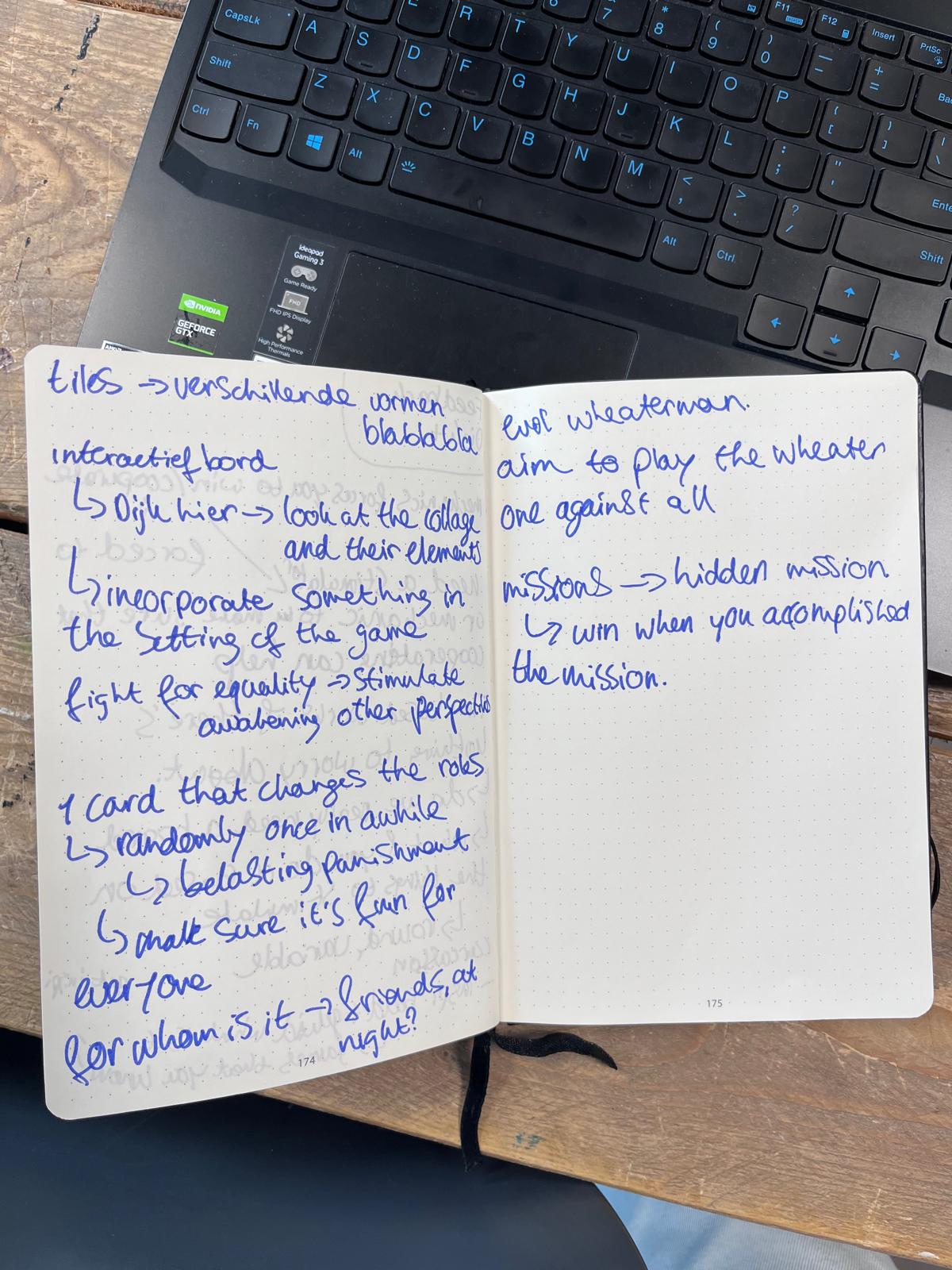
- What was their feedback regarding the mechanics?
- What could be changed to improve it?
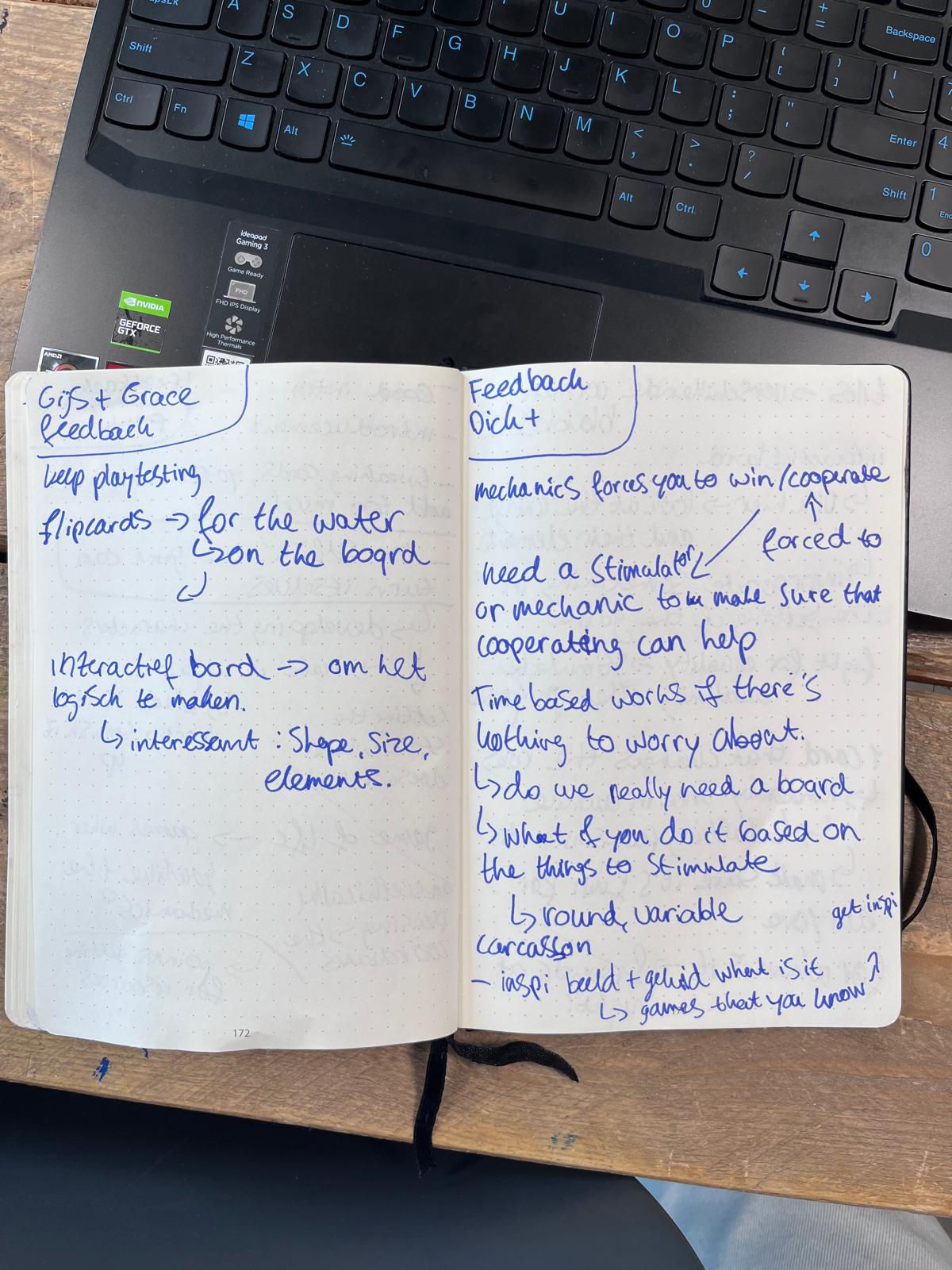
What are your action points for the upcoming day?